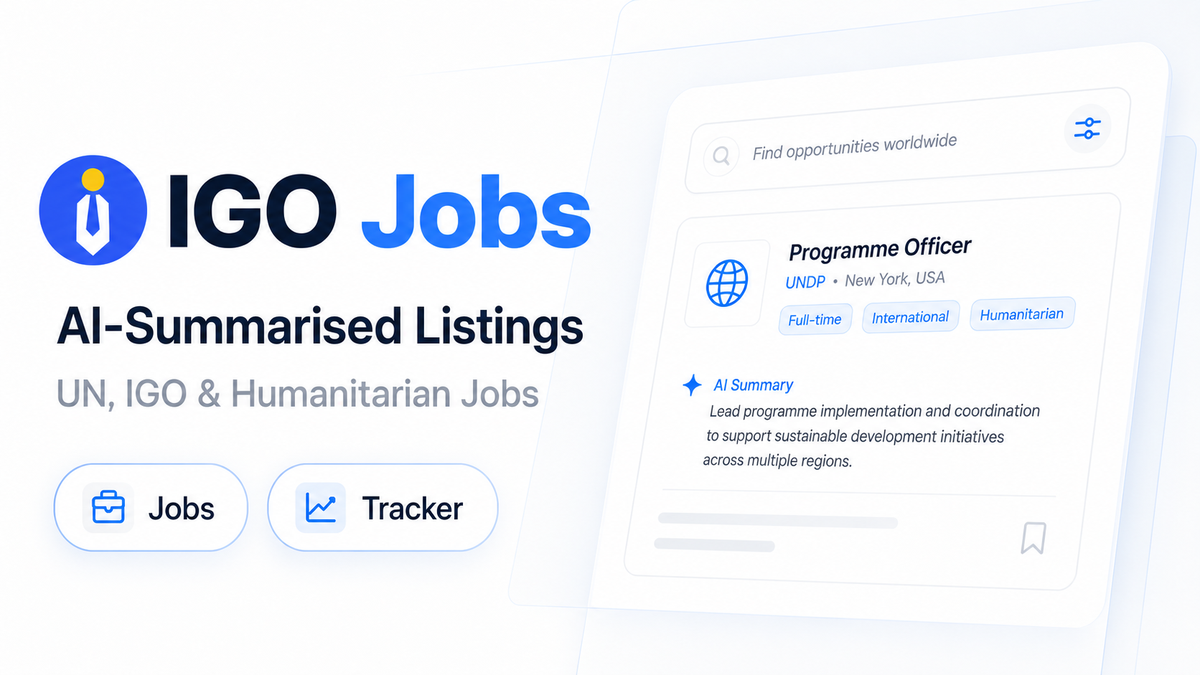
IGO Jobs
Built a focused job board and tracker for UN and IGO roles.
IGO Jobs started from a practical and personal problem. Finding the right international organisation roles takes too much time because opportunities are scattered across different websites, portals, formats, and application systems. I wanted one cleaner place to discover relevant roles, understand them quickly, and keep track of what was worth applying to.
The product combines a public job board, AI-summarised listings, organisation pages, saved jobs, profiles, CV parsing, and an application tracker. The goal is not just to show vacancies, but to make international job search easier to scan, compare, save, and act on.
Behind the interface is a separate backend layer with scheduled collectors pulling from different APIs, career portals, and public sources. Each source is cleaned and wrapped into fixed contracts so the system can handle inconsistent data without making the frontend messy.
Once jobs are collected, automatic enrichment turns raw postings into better structured listings. Roles are categorised, summarised, normalised, and prepared so users can filter by organisation, location, job function, seniority, language, contract type, remote status, deadline, and other useful signals.
The app is built with Next.js, with a focus on fast browsing, clean job pages, useful filtering, application tracking, and organic search growth. The long-term focus is to make individual job and organisation pages rank organically, while keeping the product useful for people actively managing an international job search.
One of the more useful parts is the candidate workflow. A user can create a profile, upload a CV, have it parsed into structured fields, save jobs, mark applications, export tracker data, and keep deadlines visible. The system is built around the reality that applying to international organisations is not one action. It is a long process of discovery, filtering, documentation, follow-up, and remembering where everything stands.
What made this project interesting was the combination of product, data, automation, search, AI, infrastructure, and domain knowledge. It was not only about scraping jobs. It was about turning fragmented public vacancy data into a coherent product experience that can support an actual job search.